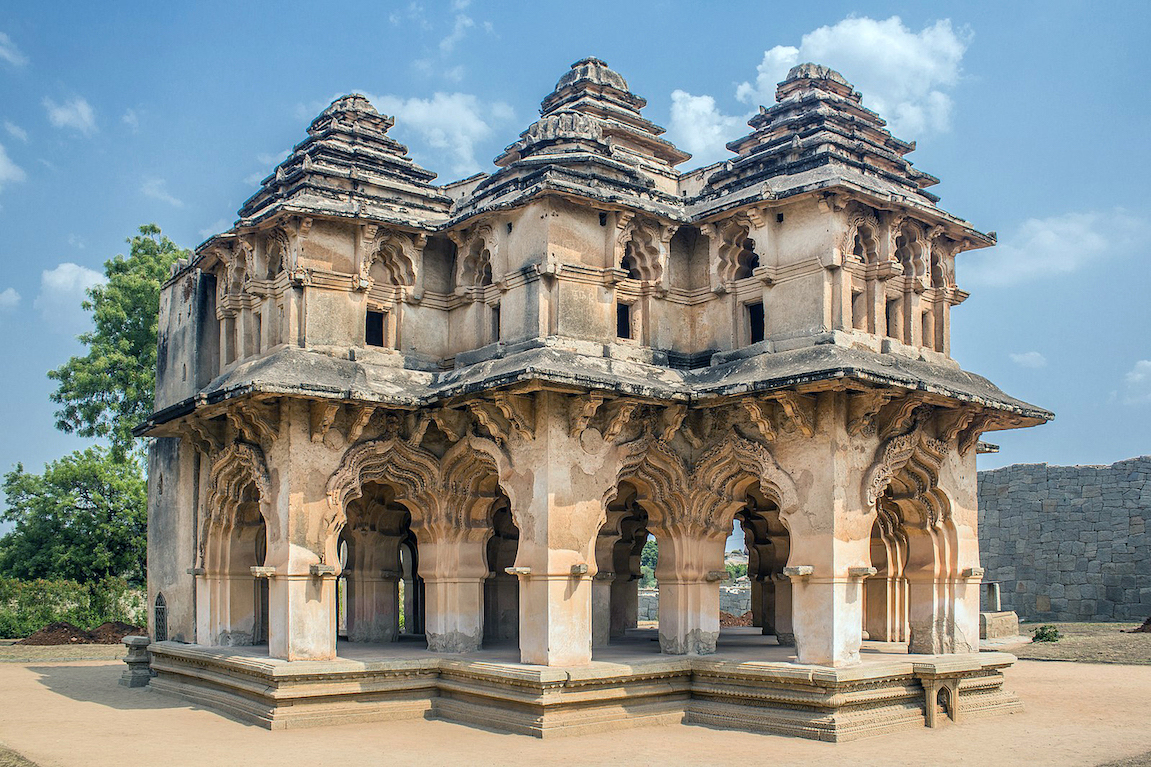
The Vijayanagara Empire was established in 1336 by Harihara I and his brother Bukka Raya I of the Sangama Dynasty. This empire emerged as a political and military response to the growing Islamic invasions that had threatened South India by the end of the 13th century. The empire's origins were tied to the remnants of earlier South Indian powers such as the Hoysala, Kakatiya, and Pandyan empires, whose former territories and influences were absorbed into the new state.
The capital of the empire, Vijayanagara, located in modern-day Hampi (Karnataka), became a major center of administration, trade, and culture. The ruins of the city, which are now a UNESCO World Heritage Site, stand as a testament to the grandeur of the empire. The empire's geographical expanse spanned from the Tungabhadra River in the north to the Krishna River in the south, making it one of the largest and most powerful kingdoms in South India during its height.
During the early years, Harihara I consolidated power in the region, extending the kingdom’s control over much of the area south of the Tungabhadra River. His military prowess earned him the title Purvapaschima Samudradhishavara("master of the eastern and western seas"). After his death, Bukka Raya I continued his legacy by defeating neighboring rulers, including the Sultan of Madurai and the Reddys of Kondavidu, and by gaining control of Goa and other important territories in the Tungabhadra-Krishna Doab.
The empire flourished under the rule of Harihara II, who succeeded his brother Bukka Raya I and extended Vijayanagara's influence over most of South India. The empire reached its peak during the reign of Deva Raya I and his successor, Deva Raya II. Deva Raya II (1424–1446) was particularly notable for his military campaigns, including successful engagements with the Gajapatis of Odisha, and his strengthening of the kingdom through fortifications and irrigation projects. Foreign visitors, such as the Italian traveller Niccolò de' Conti, regarded him as one of the most powerful rulers in India.
The Vijayanagara rulers were religiously tolerant, and they supported multiple sects of Hinduism and even maintained a degree of Islamicate practices at court. The founding kings, Harihara I and Bukka Raya I, were devout Shaivas(worshippers of Shiva) but made significant grants to the Vaishnava order, particularly the Sringeri Matha, which was led by Vidyaranya, their spiritual advisor. They chose Varaha (an avatar of Vishnu) as the royal emblem, reflecting their syncretic approach to religious patronage. The Saluva and Tuluva kings, who followed, continued this tradition, with many of them being strong devotees of Vaishnavism, yet they also revered Lord Virupaksha (Shiva) at Hampi and Lord Venkateshwara (Vishnu) at Tirupati.
The Vijayanagara Empire is also remembered for its role in promoting art, literature, and architecture. Under rulers like Krishnadevaraya (1509–1529), the empire became a vibrant cultural hub. Krishnadevaraya was not only a warrior king but also a patron of the arts, commissioning works like the Jambavati Kalyanam, a Sanskrit epic. His reign saw the empire's military, economic, and cultural zenith, with flourishing Kannada literature and a vibrant artistic tradition.
However, the empire's power began to decline after the catastrophic defeat at the Battle of Talikota in 1565. The combined forces of the Deccan Sultanates dealt the Vijayanagara forces a crushing blow, and the city of Vijayanagaraitself was sacked. Despite its fall, the Vijayanagara Empire continued to exist in a diminished form until 1646, but it was never able to recover its previous glory.
In conclusion, the Vijayanagara Empire played a significant role in defending South India against external invasions, particularly from the Delhi Sultanate and the Deccan Sultanates. It became a symbol of South Indian resilience, blending cultural, religious, and military traditions from across the region and beyond. The legacy of the empire, especially through its architectural and cultural achievements, continues to influence South Indian society to this day.
Comments
Post a Comment